Caduceus
An Ouronet bridge
Autonomic bridge between the Ouronet virtual blockchain and fourteen external chains. Caduceus holds custody on the foreign side, listens for deposits, and mirrors value onto Ouronet as DPTF tokens. The reverse leg — burn on Ouronet, release on the foreign chain — runs on the same rails.
What Caduceus is
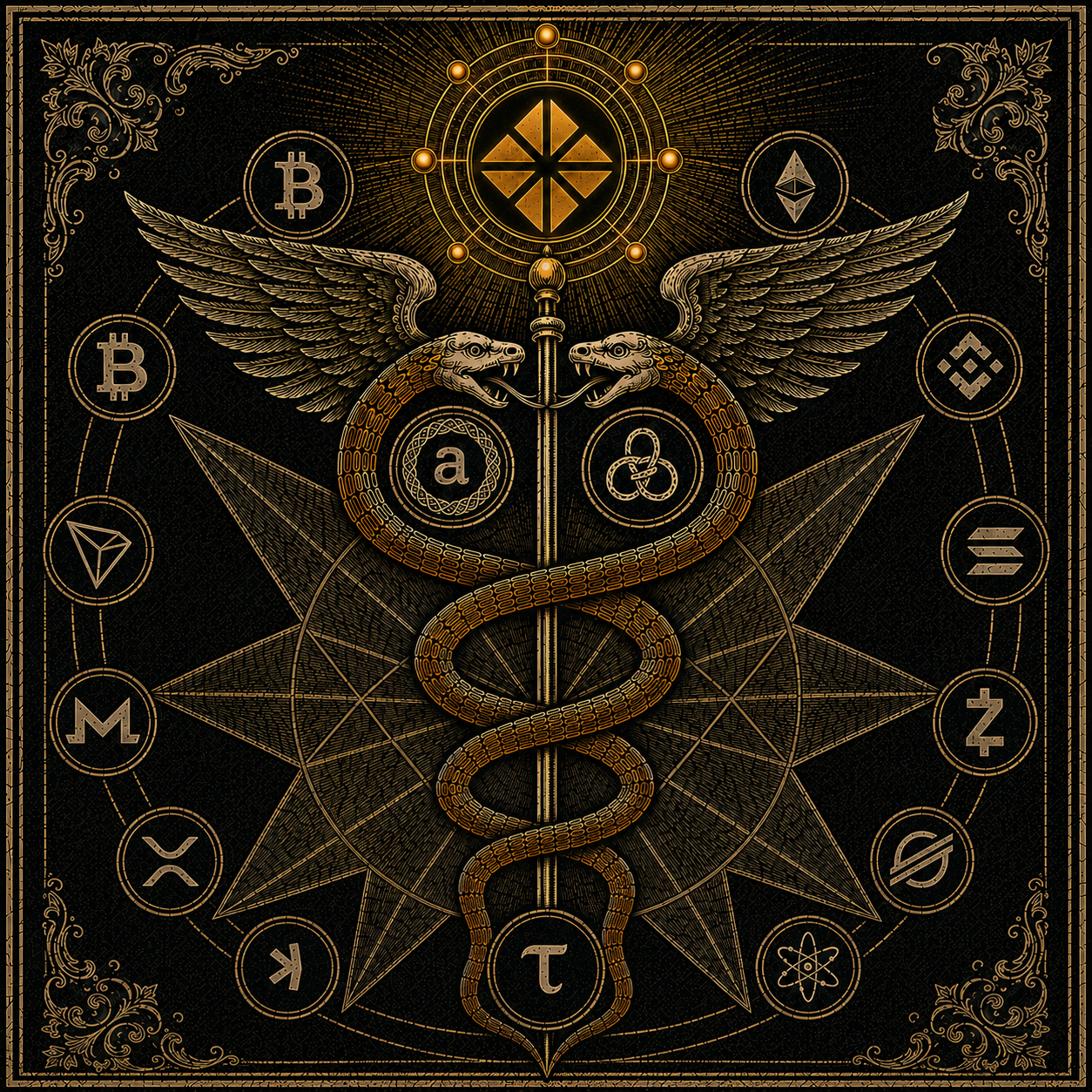
The name is intentional. The caduceus — two serpents intertwined around a winged staff — is the classical symbol of mediation between worlds. That is what the bridge does: it speaks the foreign chain's native transaction language on one side, and Pact on the other.
Caduceus is developed and operated under the AncientHoldings.eu hub and runs as a Docker service on hub-controlled infrastructure. Value moves across the boundary between Ouronet — a Pact-based virtual chain running on StoaChain™ — and foreign L1s through a small, modular adapter per chain. Modules are added in strict tier order: ship the cornerstone first, then expand outward.
Modules — Seven Tiers
Caduceus is built modularly. Each module bridges Ouronet to exactly one foreign chain. Arweave forms the Foundation — its bridged AR anchors sSTOA liquidity. The other thirteen target chains are organised into seven tiers around it by strategic importance; build order follows tier order.
Arweave
Bitcoin
Ethereum
Bitcoin Cash
BNB Chain
Tron
Solana
Monero
Zcash
XRP Ledger
Stellar
Kaspa
Cosmos
Bittensor
How it works — three transactions
Every bridging operation — deposit or withdrawal — is exactly
three signed transactions. The first and third land
on Ouronet (Pact); the middle one lands on the foreign chain. A
two-phase commit on an on-chain
bridge-ledger table means the operation either completes
(FINALIZED) or unwinds
(VOIDED) — it never gets silently stuck in between.
Notarize
User submits notarize-deposit declaring the foreign
chain, the destination Ouronet account, and the expected amount.
Bridge-ledger records status NOTARIZED
and returns a bridge-id. The $50 USD minimum is
checked here against the oracle price.
Deposit
User sends the native asset to the
single shared bridge custody address for that
chain — not a per-user address — embedding the
bridge-id in the transaction (Arweave tag, Bitcoin
OP_RETURN, Ethereum calldata, Solana memo, etc.).
One address serves every user; the binding registry plus the
embedded id disambiguate who sent what.
Finalize
After N confirmations Caduceus's sniffer submits
finalize-deposit. The ledger flips to
FINALIZED and the per-source
DPTF-<asset>.<chain> cent mints to the
recipient, minus the 1‰ bridge fee. If the on-chain deposit
doesn't match the notarization, void-deposit sets
VOIDED instead — funds are recoverable, no mint.
Notarize
User submits notarize-withdrawal with their foreign
destination address and amount. The DPTF is
escrowed (locked, not yet burned). Status
NOTARIZED; bridge-id returned.
Release
Caduceus's releaser builds the foreign-chain transaction, signs
it with the operator key (HSM-held), and broadcasts from the
shared custody address to the user's destination — with the
bridge-id in the memo. Bridge pays foreign-chain
gas out of its per-chain reserve.
Finalize
Once the release confirms, Caduceus submits
finalize-withdrawal: the escrowed DPTF is
burned and the ledger entry becomes
FINALIZED. If the release failed,
void-withdrawal sets
VOIDED and the escrow is released
back to the user.
NOTARIZED,
FINALIZED, VOIDED) is a Pact event on
StoaChain — replicated, auditable, and the basis for
proof-of-reserves.
Ecosystem
Caduceus is one service inside a wider ecosystem built on StoaChain™ and operated by AncientHoldings.